

Last week, I was out for a walk and saw a guy working on a two-storey roof, maybe two feet from the edge. No guardrail or harness. Just him, a flat roof, and an easy fifteen-foot drop to the ground—enough height to do serious, even fatal injury. This isn’t some dramatic, once-in-a-career thing. I see it all the time. And if you’ve spent any time on jobsites, so have you. Ask the boss, and you’ll hear the same old line: “He knows what to do.” “He’s been doing this for years.” “It was just a five-minute job.” But if “knowing” was enough, why do we still have so many close calls, property damage, injuries, and, worst of all, funerals?
Complacency Kills
It’s not just construction. In climbing, it’s usually the seasoned climbers—not the beginners—who get hurt when they skip a step they’ve done a thousand times. Pilots use checklists for every single flight, no matter how many years they’ve been flying. Airlines have some of the best safety records in the world—not because pilots are perfect, but because they never skip the checklist. That system is so effective that seasoned airline pilots were brought in to train experienced doctors at Johns Hopkins on how to use checklists in surgery.

Why? Because even experts screw up when they trust memory, gut feel, or “we’ve always done it this way.” Complacency kills—across every industry
Why Is Construction Still Hoping for the Best?
So why is it, in construction, we still hope that “common sense” will keep everyone safe? Why do we keep handing out safety manuals, tracking near misses, or sending workers to another safety course when what’s actually missing is integration? Workers don’t need more theory–they need training that shows how to build safety into the way work actually gets done.
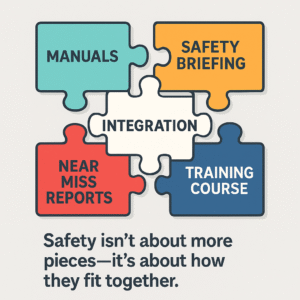
Safety Isn’t Just a Box to Check. It’s a Process.
Having safety as a “core value” means nothing if you don’t have a system to back it up. You don’t get to call yourself a safety leader because you hand out PPE and run a toolbox talk. You earn that title when every job, every task, every handoff, is planned with safety baked in from the start, not as an afterthought.
This Is Where Most Companies Fall Down
Here’s what I hear all the time:
- “Our guys know what to do.”
- “We’ve got the training covered.”
- “It’s common sense.”
If that’s true, why are there still so many injuries and close calls? Why are experienced workers still making fatal mistakes?
Because safety doesn’t happen by accident—it happens by design.
How FFS Bridges the Gap
I want to be clear: FFS isn’t a safety course. It’s a leadership and systems course designed for the real world of construction where you don’t just need to know what’s right, you need a process to make it happen, every day.
FFS teaches foremen and leaders how to build, implement, and stick to industry best practices and standards—including safety, quality, communication, and planning.
It’s about turning “should do” into “always done.”
Instead of piling on more theory, FFS gives you the practical tools and frameworks to:
➔ Plan every phase of the job so nothing is missed
➔ Communicate expectations clearly, every time
➔ Make safety and quality part of the process—not afterthoughts or box-ticking
➔ Hold yourself and your team accountable to a consistent standard
In short: FFS is the system that ensures best practices actually get implemented so you can stop relying on luck, memory, or hope.
Because safety doesn’t happen by accident—it happens by design.
The Real Cost: It’s Not Just Numbers
I’ve lost count of the news alerts I get… another worker injured, another fatality. For every one of those, there’s a crew, a company, and a family left reeling.
This isn’t about blaming workers.
It’s about building a culture—and a system—where nobody has to cross their fingers and hope they make it home.
“Common sense” is a status quo attitude.
Success is trained, modeled, and enforced by leaders who build systems that don’t leave anything to chance.
If you think training and hope are enough, ask yourself: would you trust your family’s future to luck? Or would you want a system that guarantees everyone goes home at the end of the day?
Let’s Talk
If you’re reading this and thinking, “That’s not me, we’re solid on safety,” prove it:
- Are your safety systems incorporated into every aspect of your planning and layout?
- Does every worker know exactly what to check, when, and how?
- Or do you just trust that “your guys know what to do”?
Drop your thoughts below. Agree, disagree, or got a story where a missed step nearly cost you? Let’s hear it.